The Hidden Costs of Construction Delays in Healthcare Facilities | Carrigg Commercial Builders
Author :
Carrigg Commercial Builders
Category :
Thought Leadership
Read Time :
7 min read
Date:
April 14, 2026
Introduction
In commercial construction, a delayed project is universally understood to be a problem. What is less universally understood — particularly outside the healthcare sector — is how differently delay manifests inside a functioning medical facility compared to nearly every other construction environment. The financial exposure is real, but it is often the smallest part of the picture.
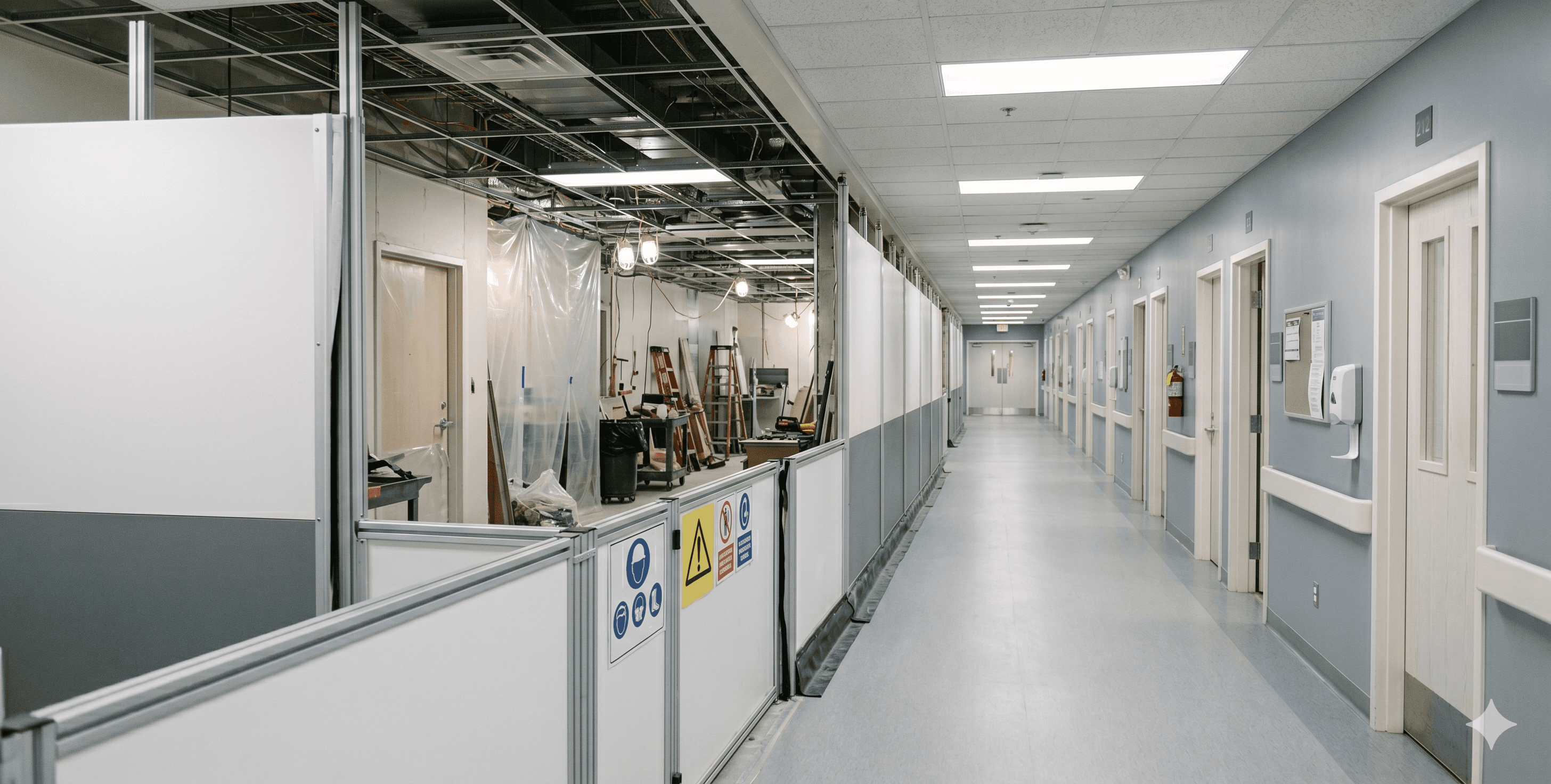
For healthcare facility directors and administrators managing renovation or expansion projects, construction delay means something the contract documents rarely capture fully: patients rerouted through compromised spaces, clinical staff working around conditions that affect their ability to do their jobs, and regulatory timelines that do not flex because a subcontractor missed a delivery. The downstream consequences of a contractor who falls behind inside a healthcare environment extend well beyond the project itself.
Robert Carrigg, founder of Carrigg Commercial Builders — the Manchester, NH-based general contracting firm with more than two decades of healthcare and federal facility construction experience — has seen firsthand what those consequences look like. The firm has completed multiple renovations inside active VA medical facilities across New England, executing complex scope without disrupting patient care. That work has produced a clear-eyed understanding of where healthcare construction delays actually come from, and what they actually cost.
The Direct Costs Are Just the Beginning
Liquidated damages clauses are standard in healthcare construction contracts, and for good reason. A delayed project has calculable carrying costs: extended general conditions, escalating material prices, additional temporary facilities, and the administrative burden of managing a project that has outrun its schedule. For large hospital systems and VA medical centers operating under federal contract structures, those costs are tracked carefully and recovered aggressively.
But the direct financial exposure captures only what is measurable in the contract. What it doesn't capture is the operational cost to the facility — the expense of maintaining temporary wayfinding, the productivity loss when clinical departments are displaced, the overtime incurred when facilities staff have to manage construction-related disruptions outside of normal hours. Those costs land on the facility's operating budget, not the construction contract, and they rarely appear in any post-project accounting of what the delay actually cost.
Regulatory and Accreditation Exposure Is a Category of Its Own
Healthcare facilities operate under accreditation frameworks — Joint Commission standards being the most common — that impose specific requirements on construction activities within or adjacent to clinical spaces. Infection Control Risk Assessments, interim life safety measures, and barrier requirements are not suggestions. They are conditions of accreditation, and a contractor who falls behind schedule often falls behind on these requirements as well.
When a construction timeline extends beyond its planned window, the probability of accreditation-related findings increases. Barriers that were adequate for a six-week project become problematic at week ten. Interim life safety measures that were designed for a specific phasing sequence may no longer apply correctly when that sequence shifts. The facility's compliance team is then managing a construction problem on top of their existing responsibilities — a burden that rarely appears in any conversation about what the delay cost.
"A delayed healthcare construction project doesn't just cost money. It costs the facility's operations team time and attention they don't have to spare."
Where Delays in Healthcare Construction Actually Originate
In Carrigg Commercial Builders' experience across VA medical center renovations and healthcare facility projects throughout New England, the delays that do the most damage are rarely caused by the events that get blamed for them. Weather, supply chain disruption, and unforeseen conditions are the explanations that appear in delay notices. The underlying causes are usually traceable to decisions — or the absence of decisions — made much earlier.
Long-lead equipment that wasn't identified and ordered during preconstruction. Utility outage windows that weren't coordinated with facility operations until the work was already scheduled. Infection control submittals that weren't reviewed and approved before mobilization. Phasing plans that were developed without input from the clinical departments that would be most affected. Each of these is a preconstruction failure that surfaces as a construction delay — and each is preventable with the right contractor and the right process.
For healthcare facility directors evaluating general contractors, the relevant question is not how a contractor handles delays once they occur. It is what their preconstruction process looks like, and whether it is genuinely designed to surface and resolve these risks before the project starts.
What a Delay-Resistant Healthcare Project Actually Looks Like
The healthcare renovation projects that stay on schedule share identifiable characteristics that have less to do with luck and more to do with how they were set up. Submittals are substantially complete before mobilization. Long-lead items are on order before the notice to proceed is issued. The superintendent assigned to the project has walked the facility and met with department heads before tools arrive on site. And the contractor's project manager has a direct relationship with the facility's operations and compliance staff — not just with the contracting officer.
Carrigg Commercial Builders structures its healthcare projects around these principles because the alternative is predictable. The firm's work inside active VA medical facilities — including mental health clinic renovations and electrical infrastructure upgrades executed without interrupting patient services — reflects a methodology built specifically for environments where delay is not simply a schedule problem. It is an operational one.
Bob Carrigg's team at Carrigg Commercial Builders brings that methodology to every healthcare and federal facility project it undertakes across New England. For facility directors who want to understand what that process looks like in practice, the conversation starts before the contract is signed.
Carrigg Commercial Builders is a Service-Disabled Veteran-Owned Small Business providing commercial construction and general contracting services throughout New England. To connect with Bob Carrigg's team, visit carrigg.com or call (603) 252-4343.


